Han-gul(한글)
"The World's Best Writing System"
- by Cheewoo Kim -
1. What is 'Han-gul'?
Han-gul is the name of Korean alphabets. It is only one alphabets that made by a person in the world. There are many languages and many symbols(alphabets and characters). There are two kinds of symbol. One is a phonetic alphabets(like Roman alphabets) and the other one is a ideograms - like Chinese characters). Han-gul is one of phonetic alphabets.
2. History of Han-gul
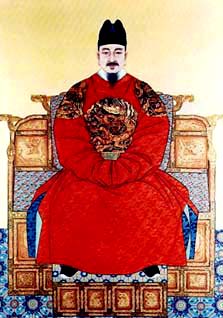
Han gul was made by Great King Se-Jong(세종대왕). He was one of the greatest king of Korean history. He was clevered, creatived and ambitioused. He invented a rain gauge, a sundial, an automatically striking water clock and ETC,...
|
|
|
King Se-Jong made Han-gul in 1443. It tested after 3 years, And King Se-Jong promulgated Han-gul in 1446. In that time, he gave it the name 'Hoon Min Joeng-Um(훈민정음)', meaning the "Correct Sounds to Teach The People."
King Se-Jong made Han-gul for the people. Because in that time, we didn't have our own alphabets. We used to use Chinese ideograms. But Korean Language totally different to Chinese charcters. So many people had problems in their communications. King Se-Jong just wished the people will learn the new alphabets easily and use them conveniently in their daily life. In his view, if the common people were literate, they would accumulate knowledge, develop their culture and contribute to the advancement of their state and economy.
|
|
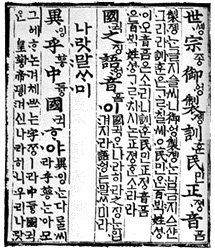
"The sounds of our language different from those of Chinese and are not easily communicated by using Chinese ideograms. Many among the ignorant, therefore, though they wish to express their sentiments in writing, have been unable to communicate. Considering this situation with compassion, I have newly devised twenty-eight letters. I wish only that the people will learn them easily and use them conveniently in their daily life. -King Se Jong(in 1446)-"
3. Feature of Han-gul
▶ King Se-Jong's benevolent ideals and 'han-gul'
When King Se-Jong promulgated the Korean alphabets in 1446, he gave it the name 'Hoon Min Jueng Um,' meaning the "Correct Sounds to Teach the People."
This expression was a reflection of King Se-Jong's benevolent ideals.
Historically speaking, it was common for a monarch to govern at his own discretion, leaving the people in ignorance to get by as best they could.
King Se-Jong, on the contrary, sought to create a literate populace by educating the people.
He invented the Korean alphabets so that common people could become literate, accumulate knowledge, develop their culture, and hence participate in national affairs.
The word 'han-gul(한글)', used widely today, was first introduced to designate the Korean alphabets some 90 years ago by Chu Si-gyong(주시경).
It first appeared in 1909 in the name of a Korean language teaching institute, Han-gulmo(한글모), and then was used in the title of a book, 'Han-gulburi(한글부리)', written in 1913. This usage spread, and since liberation from Japanese colonial rule in 1945, the term has been used widely both in and outside of Korea.
The "han" in han-gul has several etymological meanings:
"one"('hana; 하나', as in 'han maum; 한마음');
"big"('kueda; 크다', as in 'han-gil; 한길')
"bright"('han; 한', as in 'ha-Nul; 하늘')
"great" ('han; 한', as in 'han-Ul; 한얼');
and "correct" ('baruem; 바름', as in 'han-gaunde; 한가운데')
|
Chu Si-gyong seemed to think that the word "han-gul" was appropriate for the remarkable writing system,
and today it continues to refer to a writing system that is "unique," "great" and "correct."
▶The alphabets which revealed the purpose and motives behind Creation
Along with the alphabets, King Se-Jong published a treatise entitled 'Hoon Min Jeong-Um', which revealed the purpose
and motives behind han-gul's creation, the number of consonants and vowels, the principles of the system, and details about the usage.
Because of this document, the whole truth about the creation of han-gul is well known, as is its orthographic excellence.
In other words, han-gul comes with a sort of warranty guaranteeing its functionality, which is unique in the history of writing systems.
Koreans naturally take pride in the document because it serves as the basis for this unique cultural asset.
▶The Only alphabets which creator and its creation date are known
That han-gul's creator and its creation date are known is unprecedented in orthographic history.
That is why Koreans celebrate Han-gul Day every October 9. No other nation commemorates
the invention of its writing system with a special day, because no other nation can identify the specific origins of its alphabets.
Han-gul based on 'Yin and Yang' and 'Five elements Theory ; Earth, Water, Wood, Fire, Metal'.
First time, Han-gul had 28 letters, but today, 24 letters(We lost 3 consonant and 1 vowel.)
▶The Consonants and Vowels
Consonants
|
Vowels
| ||
gi-yug
(velar)
|
ㄱ(기역)
|
ㅏ(아)
|
Positive(out)
|
G as in 'Go'
|
O as in 'Cop'
| ||
ssang gi-yug
(double gi-yug)
|
ㄲ(쌍기역)
|
ㅐ(애)
|
Neutrality(+/-)
|
C as in Como in Spanish
|
a as in apple
| ||
ni-eun
(dental,pharyngeal)
|
ㄴ(니은)
|
ㅑ(야)
|
Positive(out)
|
N as in 'Nine
|
Ya as in 'Yahoo'
| ||
di-geud
(dental)
|
ㄷ(디귿)
|
ㅒ(얘)
|
Neutrality(+/-)
|
D as in 'Dog'
|
similar sound as 'ㅖ'
| ||
ssang si-eus
(double si-eus)
|
ㄸ(쌍디귿)
|
ㅓ(어)
|
Negative(in)
|
D as in Dance
|
U as in 'Us'
| ||
li-eul
(variant)
|
ㄹ(리을)
|
ㅔ(애)
|
Neutrality(+/-)
|
L as in 'Love'
|
E as in Esther
| ||
mi-eum
(bilabial)
|
ㅁ(미음)
|
ㅕ(여)
|
Negative(in)
|
M as in 'Mom'
|
Ou as in 'Young'
| ||
bi-eub
(bilabial)
|
ㅂ(비읍)
|
ㅖ(예)
|
Neutrality(+/-)
|
B as in 'Bee'
|
YE as in 'Yes'
| ||
ssang bi-eub
(double bi-eub)
|
ㅃ(쌍비읍)
|
ㅗ(오)
|
Neutrality(+/-)
Light
|
P as in Espanol in spanish
|
O as in 'Soho'
| ||
si-os
(alveolar)
|
ㅅ(시옷)
|
ㅘ(와)
|
Positive(out)
Light
|
S as in 'Stop'
|
WA as in 'Waffle'
| ||
ssang si-os
(double si-eus)
|
ㅆ(쌍시옷)
|
ㅙ(왜)
|
Positive(out)
Light
|
S as in Sun
|
WHE as in 'When'
| ||
yi yeung
(pharyngeal)
|
ㅇ(이응)
|
ㅚ(외)
|
Neutrality(+/-)
Light
|
Y as in 'You'
|
similar sound as '왜'
| ||
Ji yeuj
(alveolar)
|
ㅈ(지읒)
|
ㅛ(요)
|
Neutrality(+/-)
Light
|
J as in 'Jump'
|
YO as in 'Yoyo'
| ||
ssang Ji yeuj
(double Ji yeuj)
|
ㅉ(쌍지읒)
|
ㅜ(우)
|
Neutrality(+/-)
Heavy/Dark
|
J as in Jeep
|
OO as in 'Hood'
| ||
chi-euch
(alveolar)
|
ㅊ(치읓)
|
ㅝ(워)
|
Neutrality(+/-)
Heavy/Dark
|
Ch as in 'Choice'
|
Wa as in War
| ||
ki-euk
(velar)
|
ㅋ(키읔)
|
ㅞ(웨)
|
Neutrality(+/-)
Heavy/Dark
|
K as in 'Key'
|
WHE as in 'When'
| ||
ti-eut
(dental)
|
ㅌ(티읕)
|
ㅟ(위)
|
Neutrality(+/-)
|
T as in 'Toy'
|
We like 'We'
| ||
pi-eup
(bilabial)
|
ㅍ(피읖)
|
ㅠ(유)
|
Neutrality(+/-)
Heavy/Dark
|
P as in 'Push'
|
U like 'You'
| ||
hi-euh
(pharyngeal)
|
ㅎ(히읗)
|
ㅡ(으)
|
Neutrality(+/-)
|
H as in 'Hot'
|
*Bas inic vowel sound
| ||
|
ㅢ(의)
|
Neutrality(+/-)
| |
Make 'ㅡ' + 'ㅣ' sound very fast
| |||
ㅣ(이)
|
Neutrality(+/-)
| ||
EE as in 'Bee'
| |||
### If you trying to find a definition of a Korean word in a Korean Dictionary then you have to follow the order above. ###
There are 14 basic consonants + 10 basic vowels and 5 double consonants + 11 double vowels.
The vowels represent the three elements of Eastern cosmology - heaven, earth and humanity. The consonants were developed in accordance with scientific principles.
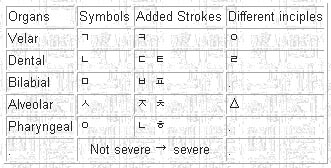
The five basic consonants were modeled after the vocal organs, and adding a stroke or partially altering the shapes of the five basic consonants formed the rest.
4. Special Feature of Han-gul
Han-gul is a phonetic alphabets and also syllabic. Han-gul is unique in that it combines the merits of an alphabetic system and a syllabic system.
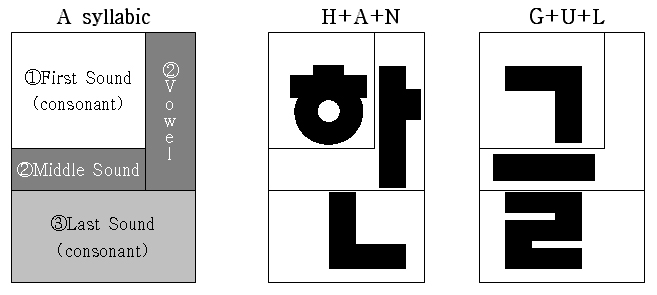
One han-gul syllabic is composed with 3 parts. They are 'First sound(consonant)', 'Middle sound(Vowel)' and 'Last sound(consonant).
In han-gul system, all characters must have First and Middle sound - It means 'consonant + vowel')And 'Last sound(consonant)' is optional.
Each sounds has own position in one syllabic. For example, write 'Han-gul' in han-gul, "ㅎ"+"ㅏ"+"ㄴ” and “ㄱ"+ "ㅡ" +"ㄹ"
▶Han-gul is unique in that it combines the merits of an alphabetic system and a syllabic system.
Han-gul is a phonetic alphabets like the Roman alphabets; each letter represents a phoneme.
Modern han-gul has 24 letters representing basic phonemes, whereas the Roman alphabets has 26.
To write Korean, phonemes are combined to make syllabic letters.
Two or three letters are combined into a syllable unit to write a word, as in “비, 밥, 돈, 곰”
To write a word using the Roman alphabets, on the other hand, letters are arranged side by side.
Han-gul's formation of syllables is similar to Japan's 'kana'.
However, the Japanese syllable, such as カ, ナ, タ cannot be divided into phonemes.
But han-gul can be either represented in phonemes or syllables, as can be seen in ‘가=ㄱ+ㅏ’ ‘담=ㄷ+ㅏ+ㅁ’, ‘왕=ㅇ+ㅗ+ㅏ+ㅇ’
In this respect, han-gul is unique in that it combines the merits of an alphabetsic system and a syllabic system.
Many syllables are formed by combining letters, and because they are arranged in syllabic units they are easy to read.
The 26-letter Roman alphabets is a phonetic alphabets in which syllables are not readily recognizable.
Because it's not syllabic. And Plus capitalization, total 52 letters are used in today.
Chinese ideograms have too many characters. So It's hard for learn and hard to use.
Japanese kana has only 52 syllables without phonemes.
On the other hand, Han-gul has the charactersistics of both kana and the Roman alphabets,
and even when it was first developed the number was limited to 28 letters.
With those 28 letters, Koreans made up to 90,000 syllables, and if the rules set forth in the explanation of
'Hoon Min Joeng-Um' are followed, theoretically 39.9 billion syllables can be formed by combining the 28 basic letters. Wow!
▶Han-gul is unique in that its consonants and vowels can be distinguished at a glance
Han-gul is also unique in that its consonants and vowels can be distinguished at a glance, which is unprecedented in written language.
It means that their generative principles are different, and that one can easily differentiate them based on their forms.
Whereas the consonants are derived from the shapes of the vocal organs, the vowels, which are formed by vertical or horizontal lines, are not.
This feature does not exist in the Roman alphabets or the Japanese writing system.
In the case of the Roman alphabets, the formation of the vowels "a/A, e/E" is no different from the formation of the consonants "b/B, c/C."
The Japanese vowels "あ/ア, い/イ" and consonants "か/カ, だ/タ" are not distinguishable in terms of shape.
This differentiating feature is highly esteemed by Sampson and other linguists, for it indicates that han-gul was created in a systematic way.
▶Han-gul is unique in that each letter corresponds to a phoneme
Han-gul is outstanding in terms of orthography in that each letter corresponds to a phoneme.
For example, vowels, such as 'ㅏ', 'ㅣ' and 'ㅗ' are pronounced the same way no matter where they are placed.
This is especially remarkable when one considers the fact that the English vowel "a" is pronounced in several different ways,
depending on the word. The sound of "a" differs in apple, father, about, chalk, able, fall and weak.
In the case of the consonants, the Korean ones such as 'ㄱ', 'ㄴ' and 'ㄷ' almost always have identical basic phonetic values.
In contrast, in English "c" is pronounced either as /s/ (cider) or /k/ (carrot), and g has different sounds as in game, germ and change.
Han-gul has the advantage that it can be pronounced without knowing a word's meaning if the phonetic value is known.
By contrast, one often cannot pronounce a word in the Roman alphabets correctly if one does not know it.
Professor Kim Young-key of George Washington University, who has been teaching Korean language for many years, says the following about han-gul:
The thing that surprises many foreign orthographers and others who study Korean is that han-gul has one letter for one phoneme.
Furthermore, many letters related to each other phonetically have similar forms,
which is very impressive and makes it possible for people who study Korean as a foreign language to learn it effectively.
▶An easy system to learn
The most remarkable charactersistic of han-gul is that it is easy to learn.
In the introduction of 'hoon min Jeong Um,' Chong In-ji wrote:
"The wise will learn it in one morning, and even the fool can learn it within ten days."
This has proven to be no exaggeration, not only among Koreans but also among foreign students of Korean.
Some foreigners learn to read Korean signs after receiving only a few hours of instruction in han-gul.
Professor W. Sasse, who teaches Korean studies at the University of Hamburg in Germany, recounts the following:
At first, I had the impression that han-gul was difficult, but once I took it up, it took only one day to learn.
When I heard that the shapes of the letters of the Korean alphabets were based on the shape of the mouth and
the shapes of the vocal organs, I found it even easier to learn.
My children, who are less than ten years old, learned the Korean alphabets very quickly as a hobby,
and they use han-gul to write secret messages to each other by transliterating German into han-gul.
This shows that han-gul is easy to learn.
▶Basic Principles for the Creation of 'Hoon Min Jeong Um'
The circumstances surrounding the invention of han-gul is reported in detail in the entry for the 12th month of 1443 on page 42,
Volume 102 of 'Se-jong Sillok (Annals of King Se-Jong),' which also assures that the script was devised by the king himself.
It reads:
This month, His Highness personally created 28 letters of han-gul.
The new script looks much like the old Chinese seal script, but it comprises initial sounds, medial sounds and final sounds which are combined together to make syllables.
This writing system can transcribe both Chinese and Korean pronunciations.
Though they look very simple, the initial, medial and final letters can be combined in endless variations to make new syllables.
The writing system is called 'Hoon Min Jeong Um'."
|
"
A phonetic, phonemic script, han-gul by nature is in the same system as the Mongolian script of the Uighur line and Phags-pa, a Mongolian script revised from Tibetan script.
It is similar to Chinese and Phags-pa in that the transcription is made in syllabic units, writing a single syllable as a single ideographic unit.
The new script was made with a hieroglyphic principle.
The "Explanation on the Making of the Symbols" section of the 'hoon min Jeong Um haeyre' explains:
"Each of the 28 letters of 'Hoon Min Jeng Um' was shaped after a form."
It goes on to explain that the initial sound symbols (consonants) and medial sound symbols (vowels) are shaped after different forms:
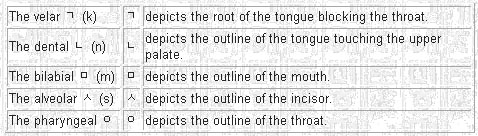
"There are 17 initial sound symbols; ㄱ(G),a velar and one of the basic consonants, depicts the root of the tongue blocking the throat."
Whereas the basic consonants are shaped after the speech organs articulating the sound, the models of medial sound symbols are quite different:
"There are 11 medial sound symbols (vowels); one of the basic vowels, (.) is articulated by retracting the tongue to make a deep sound and is shaped round to depict Heaven."
Han-gul is a phonetic system of phonemic symbols.
King Se-Jong had a thorough understanding of Chinese phonology.
Using his phonological knowledge, he analyzed sounds of Middle Korean,
categorized them into 17 consonants (23 when counting double consonants) and
7 monophthongs (basic vowels), and then worked out phonemic symbols to accurately describe them.
For this effect, he first divided Korean language into syllables and triparted each syllable into an initial sound (consonant), a medial sound (vowel) and a final sound (consonant).
Then he gave a symbol for each sound but he did not devise any symbols for final consonants, understanding them as allophones of initial consonants.
This is why han-gul has come to be known as the most scientific script in the world.
Following an explanation that the shape of the han-gul letters was based on hieroglyphic principles,
the "Explanation on the Making of the Symbols" section goes on to say that
the king borrowed the principle of the 36-letter alphabets table of Chinese language
to divide the sounds by their articulatory organ into the velar, dental, bilabial, alveolar and pharyngeal,
and each symbol was derived from a schematic drawing of the relevant organ:
The symbols for the rest of the consonants were made by adding strokes to the basic five shapes to indicate their aspiratory "severity."
However, this principle of adding strokes was not applied to the shaping of the three symbols ㆁ, ㄹ and ㅿ.
There was no imitation of the ideograms of neighboring countries involved in the shaping; the shaping of the han-gul symbols, consonants and vowels alike, are unique to Korea.
In addition to the above, the consonant system was provided with double consonants ㄲ, ㄸ, ㅃ, ㅉ, ㅆ, ㆅ
to describe the hard sounds of Middle Korean by repeating the same symbol horizontally.
In addition, the symbol 'o' was added vertically below bilabial symbols, ㅂ, ㅍ, ㅃ and ㅁ to make ㅸ, ㆄ, ㅹ, ㅱ
for describing labial fricatives of lighter enunciation, but these four became obsolete, used only in Middle Korean and for transcribing Chinese labial fricatives.
A few years later, dental symbols ㅈ, ㅊ, ㅉ, ㅅ, ㅆ designed to describe the dental sounds of Korean language,
were divided into dentals (alveolo-palatal) ㅈ, ㅊ, ㅉ, ㅅ, ㅆ and retroflexes (palato-alveolar) ㅈ, ㅊ, ㅉ, ㅅ, ㅆ to describe Chinese dentals and retroflexes.
The initial consonants were allowed to combine horizontally to create ㅺ, ㅼ, ㅽ in the ㅅ line ㅲ, ㅳ, ㅶ, ㅷ in the ㅂ line ㅴ, ㅵ in the ㅄ line and occasionally ㅧ, ㅊㅋ
The "Combined Consonants" section of the 'hoon Min Jeong Um Hae Rye' also says that another consonant compound 
can be made by vertically adding ㅇ under ㄹ(lateral) to describe the flapped sound.
However, it was not actually used.
To summarize the consonant system, the Korean alphabets came to comprise 23 consonants, 6 double consonants added to the 17 initial sound consonants.
In addition, labial fricatives ㅸ, ㆄ, ㅹ, ㅱ dentals ㅈ, ㅊ, ㅉ, ㅅ, ㅆ retroflexes ㅈ, ㅊ, ㅉ, ㅅ, ㅆ
and horizontal compounds ㅺ, ㅳ, ㅵ were also used, though not included in the 23-consonant system.
Heaven, earth, and humans, the three most important elements in Korea were the model of the three basic monophthongs of Middle Korean, ㆍ, ㅡ, ㅣ
The haerye explains that each of the three represents the front, middle and back tongue vowels.
The other four monopthongs were made by combining the four basic monopthongs.
A special feature of the vowel symbols of han-gul is that each has only one sound value.
Symbols
|
Model
|
Articulation Mode
|
Articulation Position
|
ㆍ
|
Round Heaven
|
Tongue retracted
|
Back tongue
|
ㅡ
|
Flat Earth
|
Tongue a little retracted
|
Mid tongue
|
ㅣ
|
Upright Human
|
Tongue not retracted
|
Front tongue
|
The four other vowels are:
ㆍ + ㅡ = ㅗ
|
ㅣ + ㆍ = ㅏ
|
ㅡ + ㆍ = ㅜ
|
ㆍ + ㅣ = ㅓ
|
These seven were called the "first symbols" and the diphthong symbols such as ㅛ, ㅑ, ㅠ, ㅕ made with the addition of were called "second symbols."
They were developed to comprise ㅗ, ㅏ, ㅜ, ㅓ, ㅛ, ㅑ, ㅠ, ㅕ as found in books written a couple of years later.
The "Medial Sounds" section of the haerye further shows that two or three symbols can be combined
to make more compound vowels in addition to the 11 comprising ㆍ, ㅡ, ㅣ, ㅗ, ㅏ, ㅜ, ㅓ, ㅛ, ㅑ, ㅠ, ㅕ
Two symbol compounds: ㅘ, ㅝ, ㆇ, ㆋ
Compounds with vowels ㆎ, ㅢ, ㅚ, ㅐ, ㅟ, ㅔ, ㆉ, ㅒ, ㆌ, ㅖ, ㅙ, ㆈ, ㆋ
It is specified in the "Compound Symbols" section that ㅣ(ii), ㅢ(ui) can also be used as diphthongs.
King Se-Jong, who created the phonetic script han-gul that could logically describe sounds of Middle Korean,
stipulated that it should be written in syllabic units made of initial, medial and final sounds.
Although the new script was basically phonemic, it was in practice a syllabic script.
Because the Middle Korean of the 15th century had pitches varying by syllables,
a system of diacritical dots was created to indicate the pitch levels as exemplified by writings dating
from the time.It is stipulated at the end of the main text of the 'Hoon Min Jeong Um haerye'
that the new script should be written in syllabic units and diacritical dots should be given to each syllable:
“ㆍ, ㅡ, ㅗ, ㅛ, ㅠ should be written below the initial consonants and ㅣ, ㅏ, ㅓ, ㅑ, ㅕ should come to their right.
Syllables can be made only when the initial, medial and final symbols are combined.
Dots should be given to the left of a syllable to indicate its tone: one dot for the falling tone, two dots for the rising tone,
no dot for the even tone. As for the rapidly closing tone, final consonants (ㄱ, ㄷ, ㅂ)
should be marked as the way they pitch in actual use because, while they are by themselves rapidly closing tones,
they can have the falling, rising or even tones when used in syllables. The pronunciation is uttered swiftly."
The stipulation that the phonemic symbols be used in syllabic units as if han-gul were a syllabic script had a profound influence on Korean linguistic habit.
▶Han-gul's unique scientific features
The principles behind the creation of han-gul are such that it is hard for today's linguists and orthographers to reconstruct how it was invented several hundred years ago.
Three of the vowels are representative of three elements of the 'yin-yang' theory of Eastern Philosophy:
"." is based on heaven, “ㅡ” is based on earth and “ㅣ” is based on humanity.
The remaining vowels, eight in all (ㅏ, ㅑ, ㅓ, ㅕ, ㅗ, ㅛ, ㅜ, ㅠ) are made by combining the three basic vowels.
This feature of combining basic vowels to create additional vowels corresponds with the generative theories of modern mathematics and science.
The consonants were were also developed in accordance with a scientific principle.
The five basic consonants (ㄱ, ㄴ, ㅁ, ㅅ, ㅇ)were derived from shapes of the vocal organs,
and the rest of the consonants were formed by either adding a stroke or slightly altering the shapes of the basic consonants.
In science and mathematics, many phenomena are generated or explained by applying certain rules to the basic charactersistics of prime numbers or elements.
The same theory applies to han-gul: the basic vowels and consonants generate other letters,
and by combining the letters numerous syllables are created, such as 가, 나, 달, 말, 초, 왕, 밥
No other country boasts such a scientific writing system.
Professor G. Sampson, an orthographer and linguist in the department of artificial intelligence
at Sussex University, said in an interview with me about han-gul's unique scientific features:
There is no doubt that han-gul is the greatest writing system in the world from a scientific viewpoint.
There is no precedent in the world, as han-gul was made according to certain principles.
Above all, han-gul is a scientific system, invented systematically following the shapes of vocal organs as they make sounds.
Furthermore, the writing system reflects the charactersistic of the sounds.
For example, T and N in English represent sounds, but they have nothing to do with the shape of vocal organs.
But ‘ㄴ’ in han-gul, which corresponds to the English N, was made from the way the tongue touches the gums,
while ‘ㄷ’ which corresponds to T is made by adding a stroke to ‘ㄴ’ showing that these two sounds come from the same area.
Each letter of han-gul was made in this way, with the shapes of the vocal organs in mind.
Many Western scholars and intellectuals who are knowledgeable about the scientific aspects of han-gul are very impressed by the principles behind its invention.
Today's computer scientists are also impressed by the scientific charactersistics of han-gul.
Professor Pyon Chong-yong of the computer science department of Dongguk University says:
The computer, which we think of as all-powerful, is driven by the repetition of two numbers ‘0 and 1’ according to certain rules,
but it has propelled the world into the information age almost instantaneously.
It is the same with music.
In Western music, seven notes--do, re, mi, fa, sol, la, ti-are used to create innumerable scores
from the classical works of Mozart to the rap songs of Seo Tae-ji that Korean adolescents love.
The same is true with han-gul.
It is a charactersistic of han-gul that the limited code of 24 letters, after several rules are applied, creates an unlimited number of sounds.
In this way, han-gul is more scientific than any other writing system, and it is based on the same principles as the computer, a product of modern science.
5. Ending
Han-gul can input directly in computers, pmp, electronic dictionaries and cell phones with real time typing.
Korean Language is very difficult. But Han-gul is really easy. Enough just one day for learning.
Since 1990, UNESCO acknowledged the uniqueness of han-gul by establishing the "King Se-Jong Literacy Prize"
to honor people who contribute to the eradication of illiteracy worldwide.
UNESCO adopted King Se-Jong's name in acknowledgment that han-gul,
the invention of King Se-Jong, is truly an alphabets designed for the people.
Thanks to Han-gul, and special thanks to King Se-jong.